The Decision Lab
Four days to turn an AI workflow challenge into a test and a decision
The Decision Lab redesigns a real workflow around AI capabilities before the organization commits to a full build or wider deployment.
- Duration
- 4 days.
- Outcome
- A Scale, Iterate, or Stop decision.
It brings the people who own the work, the decision, and the technical context into one process.
At the end of four days, leadership has a redesigned workflow, a functional prototype tested by employees, and evidence for a Scale, Iterate, or Stop decision.
Where it starts
The technology works in the demonstration, but the work does not change
Many AI initiatives struggle to move from prototype to use because the technology is added to an existing workflow without redesigning the roles, handoffs, and decisions around it.
The model may work technically while employees remain uncertain about using it, ownership stays unclear, or conflicts between human and agent work appear after change has become expensive.
The Decision Lab begins with the work itself: how it operates today, where it breaks, what must remain human, what AI may perform, and who owns the result.
When it fits
When does The Decision Lab fit?
- You have a defined AI use case that needs to be tested inside real work.
- Budget or delivery capacity is about to be committed, but the new workflow has not been designed.
- A prototype exists, but employees are not using or trusting it.
- Business, technology, risk, and change teams are working separately.
- Roles, authority boundaries, and human accountability remain unclear.
- Leadership needs practical evidence before making a scale decision.
How it runs
Four days, four phases
Day one: Discovery
A cross-functional Discovery Pod of 6 to 8 participants brings together knowledge that is distributed across the organization.
The team maps the workflow as it actually operates, including broken handoffs, unowned steps, and decisions made without a clear basis. It then produces an initial redesign that improves the work before AI is introduced.
Day two: Design
The team defines success measures, maps risks and controls, establishes authority boundaries, and designs the interaction between employees and AI.
The day ends with a detailed storyboard showing how the new workflow operates, what the human performs, what the agent or system performs, and where human accountability remains.
Day three: Build
The client’s IT function or technology partner turns the storyboard into a functional AI prototype that an employee can experience and evaluate.
Linkgurus owns the workflow design, human and agent roles, authority boundaries, interaction sequence, tool recommendations, and working specifications.
The client’s technology function or partner owns technical architecture, data, integrations, security, prototype or agent build, deployment, and technical operations.
Day four: Validation
The prototype is tested through five structured interviews with employees who perform the work.
The interviews provide evidence about whether the redesigned workflow is usable, what needs to change, and whether the initiative deserves further investment. Leadership then makes a Scale, Iterate, or Stop decision.


What it produces, and where it stops
What do you leave with?
- A map of the workflow as it operates today.
- A redesigned human and AI workflow.
- Success measures connected to a business result.
- Mapped risks, controls, and authority boundaries.
- Defined human roles, agent roles, and accountability for the result.
- A detailed prototype storyboard.
- A functional AI prototype built by the client’s technology function or partner.
- Evidence from five structured employee interviews.
- A Scale, Iterate, or Stop decision supported by evidence.
What does it exclude?
- Technical architecture or platform selection.
- Data engineering, access implementation, or integrations.
- Security, infrastructure, or technical operations.
- Agent deployment or technical monitoring.
- Training the client team to facilitate the Lab independently.
If another route fits better
When the organization wants its own team to lead this method, the appropriate route is Decision Lab facilitator training within Your Lab.
Your Lab

Do not test the technology outside the work it is meant to change
Begin with a real workflow, the people who perform it, and the result that needs to move.
The instrument
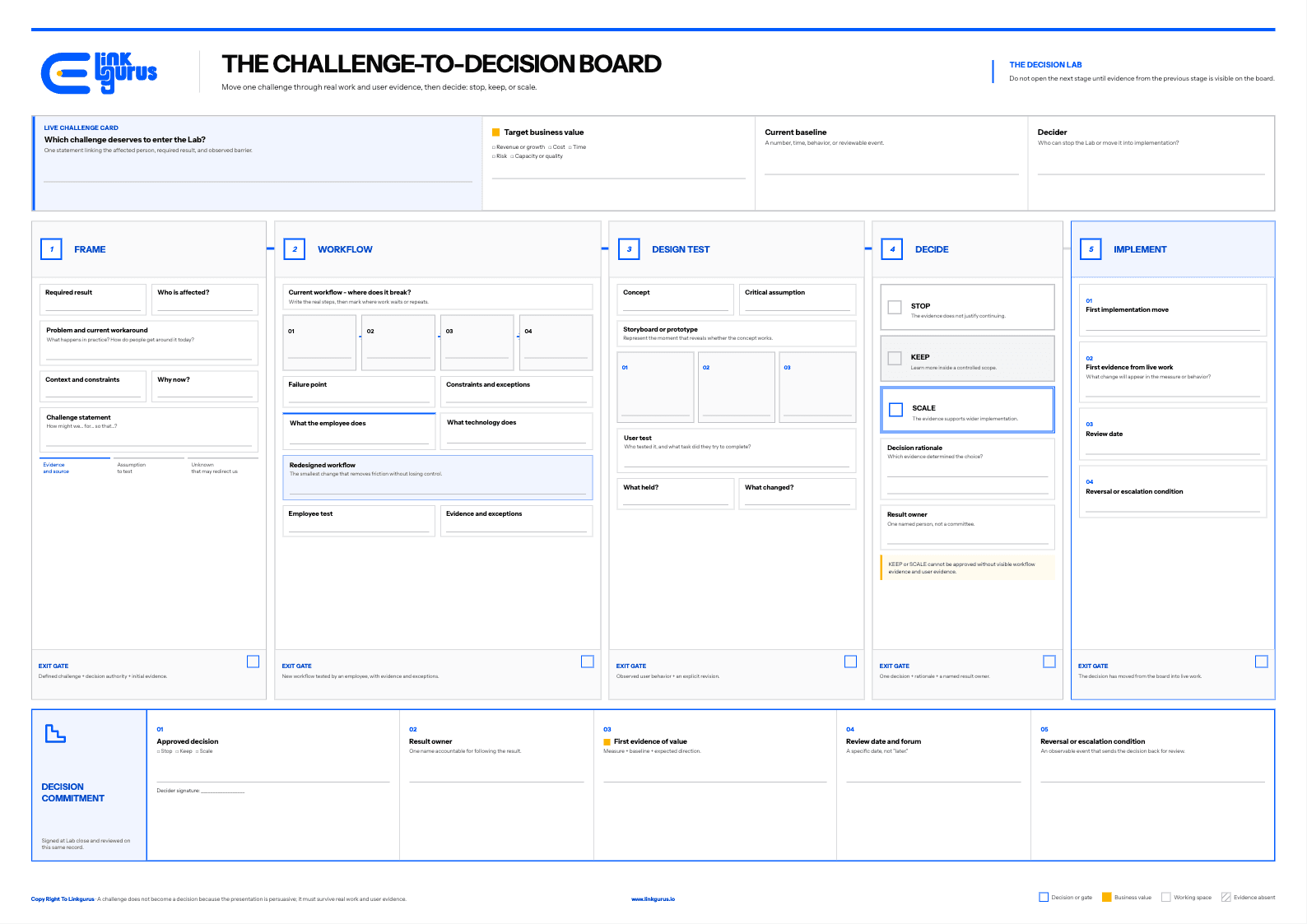
Can your team run the four days itself?
Download the Challenge-to-Decision Board and use it to structure the four days: discovery, design, build, and validation.
The board holds the four days in one place: the workflow as it operates today, the redesigned human and AI interaction, the risks and evidence recorded against it, and the decision the evidence supports.
It suits teams that already hold the facilitation capability, the decision owner, and the technical participation needed to build the functional prototype.
Want Linkgurus to lead The Decision Lab?
Bring one real workflow challenge and a defined AI use case. We prepare and lead the four phases, from discovering how the work operates today to testing the prototype with employees and reaching an evidence-supported decision.
We lead the workflow design, roles, authority boundaries, and human-AI interaction, then coordinate with the client’s IT function or technology partner responsible for building the functional prototype.