
Decide which AI challenge is worth funding.
Several bets in front of leadership, and one decision that survives the board.
Who decides, and what holds.
Challenge framing, organization design, and human–AI agent operating models.
Three situations
Three recognizable situations, each leading to a door and service best suited to it.
Several bets in front of leadership, and one decision that survives the board.
The system runs and the result has not moved, because the work never changed around it.
Decisions return upward or wait, because the threshold that would settle them does not exist.
One chain connecting the business result to structure and governance, then to human–agent work and controls, through to customer value and a hold review.
The intended business result and the challenge worth solving.
Where value is created, against which proxy and which baseline.
Roles, decision rights and authority thresholds.
The shared workflow, its boundaries and its handoffs.
Named owner, control point, escalation and reference trail.
What actually reaches the end customer after the change.
A versioned baseline, hold observation and drift correction.
Linkgurus owns the business system
Where we design together
The point where Linkgurus' business and organization design expertise meets the technical expertise of the client's IT team or technology partner.
Client IT / technology partner owns the technology
Frames the challenge, redesigns and tests the AI-enabled workflow, and transfers the method and tools to the client team.
A framed challenge. A tested decision. A capability transferred.
Redesigns authority, roles, job architecture, decisions and change so the strategy can actually operate.
Find where decisions stop. Install authority in the work. Review whether it holds.
Puts AI into real work: the workflow, the authority boundary, the named human owner, the controls, escalation, adoption and business accountability.
Locate stalled value. Name the owner of every result. Review whether the model holds.
How we work
The 6A path moves a live business challenge from diagnosis to an operating model that works and holds.
Establish where the work stops.
Fix the baseline.
Does AI enter now?
Fix who decides and what changes.
Put the design into the work.
Hold what was designed.
The instruments we work with are published as they are, with no parallel marketing version. This is one of them.
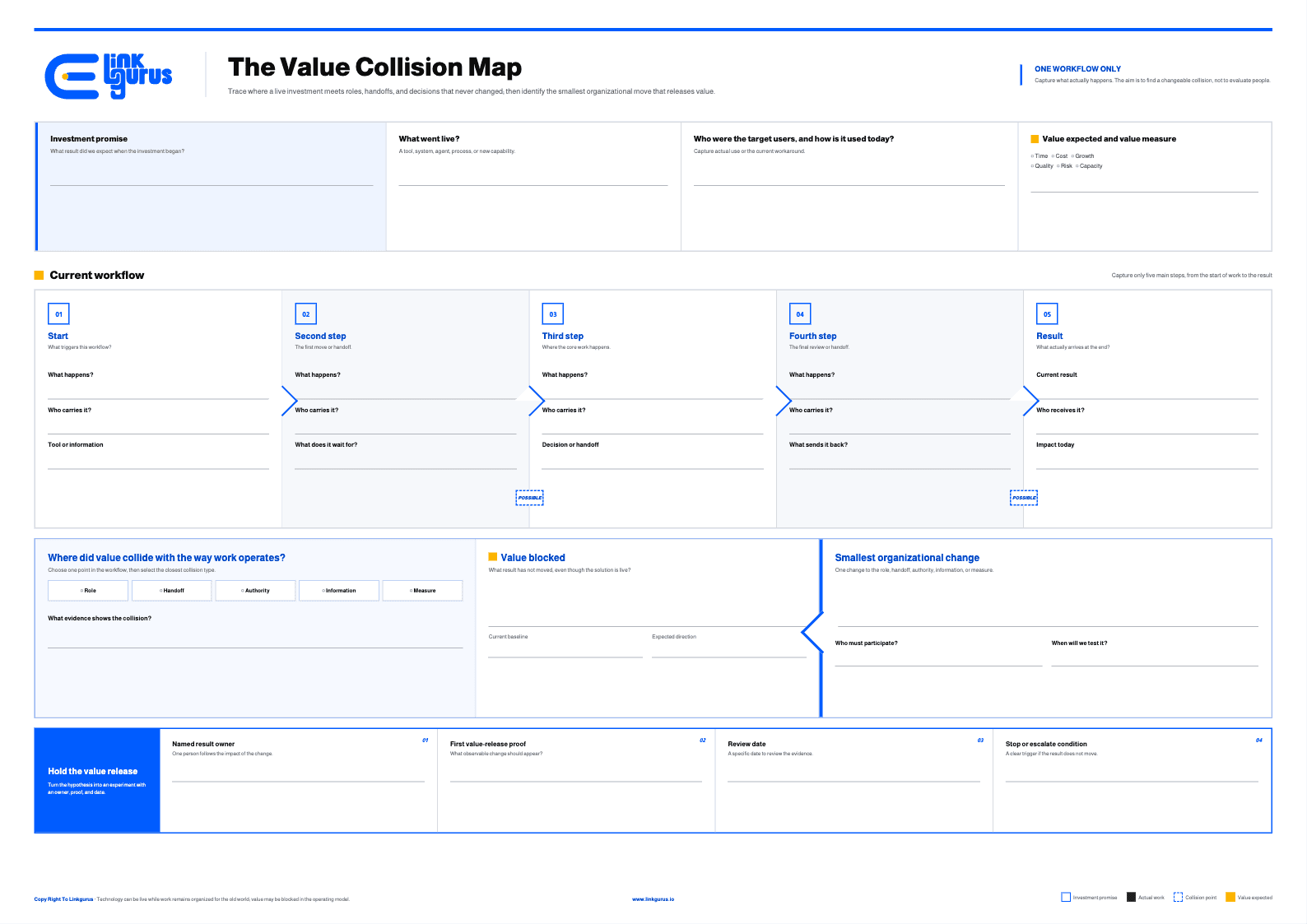
When an investment is live, the result has not moved, and you need to see where the new way of working collided with the organization.
The entry instrument of The Operating Model practice.
Organization design is not complete until it is applied and change is managed.
One fit call establishes the situation, the intended result and who holds the decision. We then propose the right route, or say plainly that we are not it.