Where Decisions Stop
One week to find where the decision loses momentum
Where Decisions Stop traces one or two real consequential decisions from request to resolution. It shows where each decision waited, who formally held the authority, who exercised it in practice, and which missing threshold kept the decision travelling upward.
- Duration
- One week.
- Scope
- One or two decisions traced.
When the same decision keeps returning to the CEO, crosses several functions without resolution, or waits for an approval nobody can clearly explain, the problem may not begin with the people involved.
Authority may exist on the organization chart without being usable in the work.
Why the delay repeats
Growth adds pressure to every unclear authority boundary
The bottleneck often begins with something that appears temporary: one additional approval, another alignment meeting, or a precautionary escalation. When the pattern repeats, delay becomes structural:
- Operating decisions continue to reach the founder or CEO.
- Several functions participate, but nobody holds the final call.
- Formal authority and exercised authority sit in different places.
- Teams escalate because value, risk, or impact thresholds are undefined.
- Decisions are reopened after leadership believed they were settled.
- The strategy is ready, but execution requires authority nobody clearly holds.
The work does not begin by asking who caused the delay.
It begins by asking where the decision stopped and what made it stop there.
When it fits
When does this engagement fit?
- The organization has grown faster than its authority model.
- Day-to-day decisions still return to one senior person.
- Functions repeatedly disagree about who owns the decision.
- Material decisions cross several handoffs before resolution.
- The formal chart no longer reflects how work is actually governed.
- Leadership needs evidence before commissioning a wider organization-design project.
- A restructuring is being considered, but the structural problem has not yet been located.
How it runs
What happens during the week?
Select the decisions worth tracing
Leadership identifies one or two real decisions showing delay, repeated escalation, or unclear authority.
Trace the actual route
We map each decision from request to resolution: who raised it, who reviewed it, where it waited, how many times it moved, and who ultimately exercised authority.
Locate the structural blockage
We compare formal and exercised authority and identify unnecessary handoffs, missing thresholds, and decisions that travel upward without a stated reason.
Establish the baseline
The findings become a measured baseline and a map of where decisions stop and which structural changes deserve attention first.


What it produces, and where it stops
What do you leave with?
- An end-to-end trace of one or two real decisions.
- A baseline for decision time and handoff count.
- Formal authority compared with exercised authority.
- Identified waiting, escalation, and reopening points.
- The missing thresholds that may permit resolution at a lower level.
- A sequenced set of structural priorities.
- Evidence to decide whether a wider organization-design engagement is warranted.
What does it exclude?
- A complete organization redesign.
- Salary-scale or total-rewards design.
- Individual performance assessment.
- Employee-exit recommendations.
- Assuming that every delay is caused by structure.
- Promising a specific decision-time improvement before the decisions are examined.
Free tool
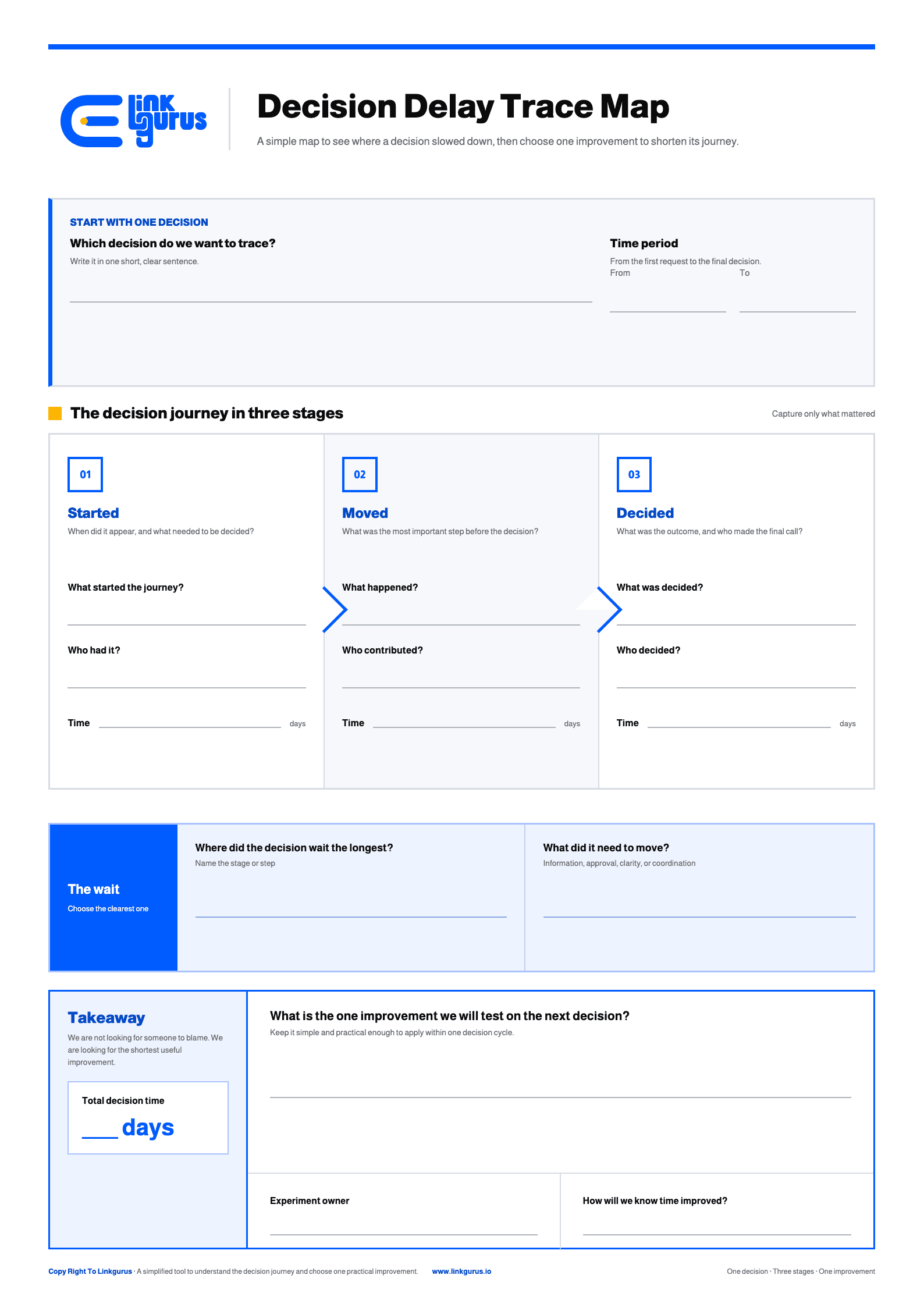
Before tracing two decisions, begin with one
The Decision Delay Trace Map is a simplified tool for mapping one decision from request to resolution. It helps you record:
- Every handoff in the decision.
- Who held each step.
- How long the decision waited.
- The formal authority holder compared with the actual one.
- The missing threshold that could have allowed resolution at a lower level.
The tool does not assess individual performance, prove by itself that the organization structure is wrong, or replace tracing several decisions when diagnosing a structural condition.
Do not redraw the organization before locating where the decision stops
Begin with 2 or 3 real decisions. From there, we can determine whether the condition requires a bounded authority correction or a wider organization-design engagement.