Value on Hold
The investment went live. The result did not move.
Value on Hold is an organizational diagnostic that locates where the new way of working collided with the actual organization. It identifies the specific change to roles, handoffs, authority, or measures that deserves testing before more technology is purchased or the investment is expanded.
- Duration
- Defined after the fit call, based on the investment scope, workflows, and functions included in the diagnostic.
The system runs. Usage is recorded. The project has been closed.
But roles, handoffs, and measures stayed where they were. Manual work continues alongside the new tool, and the result used to justify the investment has not appeared.
Why the value stays on hold
The technology works, and the old way of working continues beside it
An initiative does not need to have failed technically for its value to remain on hold. The system may operate as designed while:
- Manual processes continue alongside it.
- Roles and job descriptions remain unchanged.
- Data enters the system, but decisions are still made outside it.
- Existing handoffs and approval routes continue.
- Measures and management reports remain unchanged.
- Usage is tracked without an agreed measure of the intended result.
- The organization prepares to scale before knowing whether value has started to move.
This is not a verdict on the technology or its vendor.
The question is: what needed to change in the organization around the investment, but did not?
When it fits
When does Value on Hold fit?
- A digital or AI investment is live, but its intended result has not appeared.
- Usage has increased while performance, cycle time, or result quality has stayed where it was.
- A manual parallel workflow continues beside the new system.
- Roles, authority, or handoffs did not change after launch.
- No agreed value measure or baseline exists.
- Business, technology, and change teams have different explanations for the condition.
- Leadership is considering purchasing more technology or expanding the initiative.
- The organization does not need to label the initiative a failure, but it does need an evidence-based decision.
How it runs
What do we do?
Establish the result used to justify the investment
We begin with the result that was meant to change, not with system features or user counts.
We clarify what the organization intended to improve, who owns that result, and what evidence currently exists.
Map the workflow as it actually operates
We trace how the work happens before, inside, and after the new tool, including who performs each step and where handoffs, approvals, and parallel routes remain.
Locate the collision points
We identify where the new way of working meets unchanged roles, authority, measures, or operating practices.
The technology may be new while the organization remains designed to work without it.
Establish the value measure and baseline
Leadership agrees on an observable measure of value and establishes its current position before approving further scale or another change.
Define the smallest organizational change worth testing
We identify the clearest bounded change to a role, handoff, authority boundary, or measure. The change is connected to a named owner, evidence from live work, and a review date.
The purpose is not to assume that this change will release the value. It is to test whether the intended result begins to move.


What it produces, and where it stops
What do you leave with?
- A clear definition of the result the investment was intended to produce.
- A map of the workflow as it operates in practice.
- Identified collision points between the tool and the organization.
- An agreed value measure.
- A baseline against which change can be observed.
- The roles, handoffs, authority, or measures requiring attention.
- The smallest organizational change worth testing first.
- A named owner for introducing the change.
- The first evidence required from live work.
- A review date for examining whether the result has started to move.
What does Value on Hold exclude?
- Changing or rebuilding the system.
- Repairing integrations or migrating data.
- Assessing the technology product or vendor.
- Independent technical or security assurance.
- Establishing audited financial return on investment.
- Guaranteeing that one organizational change will release the value.
- A complete organization redesign inside the diagnostic.
- Recommending a specific platform or technology product.
If the diagnostic indicates that wider redesign of roles, authority, or the operating model is required, that work is scoped separately.
Where our work stops
Linkgurus designs organizational change and recommends the technological capabilities to support it. The client owns the technology and infrastructure.
Linkgurus owns
- Result and value framing.
- Mapping the live workflow.
- Examining roles, handoffs, authority, and measures.
- Defining the organizational change worth testing.
- Naming who owns the result and reviewing the evidence.
The client's technology function or technology partner owns
- Technical architecture and platform.
- Data access and integrations.
- Security and infrastructure.
- System development, deployment, and operation.
- Technical fault resolution.
Free tool
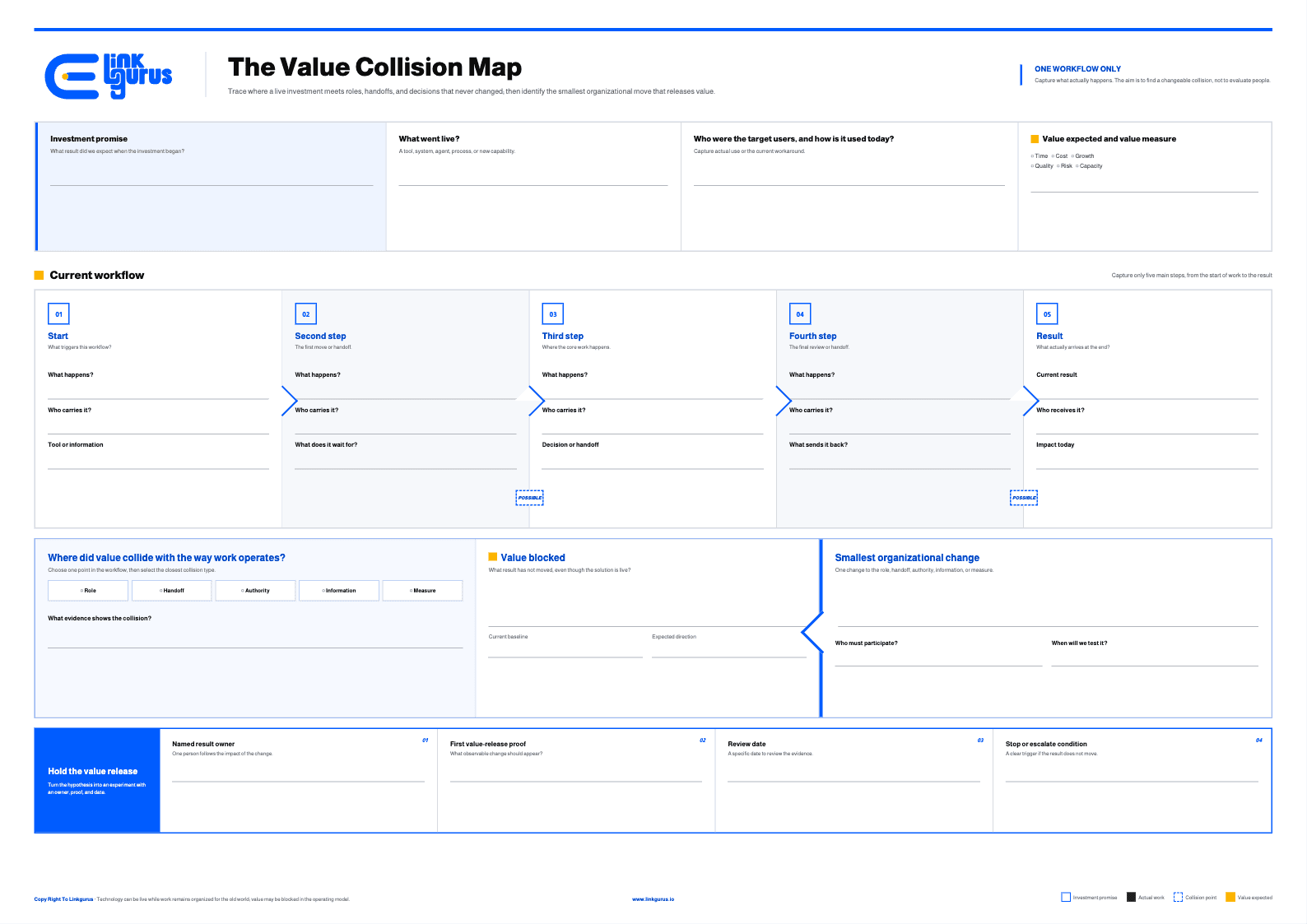
Start the diagnostic yourself before adding another investment
The Value Collision Map helps you record:
- The live workflow and its intended result.
- Collision points between the new method and existing roles.
- The value measure and its baseline.
- The smallest organizational change worth testing.
The tool does not assess the system or vendor, establish return on investment, or replace an agreed measured baseline.
Do not expand the investment before understanding why the result did not move
Begin with the result used to justify the investment and the workflow it was meant to change. We will determine whether the value is being held in the technology or in the roles, handoffs, authority, and measures around it.