AI Operating Model
Every agent needs a role and a boundary. Every result needs a named human owner.
The AI Operating Model designs the roles, workflows, authority, and controls around AI agents. It then sequences their entry into real work, function by function, with a named human owner for every result.
- Duration
- Defined after scope review, based on the number of agents, workflows, and functions included in the model.
When an AI agent begins preparing recommendations, performing steps, or producing output used in real decisions, technical operation is not enough.
The organization needs to know what the agent does, what it cannot own, when it must stop, who reviews its work, and who remains responsible for the final result.
Why the ambiguity persists
The agent entered the work before the organization defined how it should operate
An agent may begin as a bounded experiment and become part of daily work before roles and decision boundaries have changed around it. This appears when:
- Different functions use agents without a shared organizational inventory.
- Agent recommendations or output enter live decisions.
- No named human owns the result affected by an agent.
- Employees do not know when to rely on the agent or override it.
- No written escalation or human-intervention rule exists.
- Agent permissions differ from one team to another.
- No reference trail explains what the agent did and why.
- Usage expands faster than the organization can define responsibilities and controls.
The condition does not always begin in the technical model.
It may begin with the absence of an organizational model that places the agent inside a role, workflow, and clear boundary.
When it fits
When does this engagement fit?
- AI agents are operating inside one or more functions.
- The organization is preparing to move from experiments to wider use.
- Several agent initiatives are operating separately.
- Agent output affects a decision, service, or business result.
- No clear inventory identifies the agents and decisions they touch.
- A named human owner has not been assigned to every result.
- Authority, escalation, and manual override remain unclear.
- Business, technology, HR, and risk teams need a shared model.
- Leadership wants to sequence agent entry instead of expanding across every function at once.
What we design
What do we design?
Agent and result inventory
Identify current and planned agents, the functions and workflows they enter, and the results and decisions they affect.
Human and agent workflow
Map how work moves between the employee, agent, and system. Define what remains human and what the agent may execute or recommend.
Named human ownership
Assign a named human owner to every result, even when the agent performs most of the underlying steps.
The owner of the result is not necessarily the person operating the tool or the technology team that built it.
Authority boundaries
Define what the agent may:
- Execute independently.
- Recommend subject to approval.
- Access or change.
- Escalate to a human.
- Never perform.
Controls and escalation
Design review points, escalation rules, manual override, agent stopping conditions, and the trail required to understand what occurred.
Roles around the new work
Redesign employee, manager, and decision-owner roles around the agent-enabled workflow.
The agent is not simply added to the old role description. The work is redesigned around what must remain human and what may move to the agent.
Entry sequence
Sequence the model into functions according to the intended result, workflow readiness, ownership clarity, and required controls.


Governance inside the model
AI agent governance within the model
AI agent governance is a component of the operating model. It is not an alternative service name or a separate technology project.
The organizational governance defines:
- Who approves an agent entering the work.
- Who owns the result it affects.
- Which permissions the agent receives.
- Where human review occurs.
- When escalation or manual override is required.
- Which reference trail must be retained.
- Who reviews the boundaries when the agent or work changes.
What it produces, and where it stops
Final deliverables depend on the agreed scope and may include:
What can the organization leave with?
- An inventory of current and planned agents.
- A map of the functions and workflows each agent enters.
- The decisions and results each agent affects.
- A named human owner for every result.
- Human and agent workflow designs.
- Updated roles around the new work.
- Defined authority boundaries for each agent.
- Human review and control points.
- Escalation, override, and stopping rules.
- Reference-trail requirements.
- A function-by-function entry sequence.
- A baseline supporting later Accountability Reviews.
- An enactment and change-management plan.
What does it exclude?
- Selecting the technology platform or contracting the vendor.
- Implementing integrations or data engineering.
- Deploying agents or monitoring them technically.
- Security assurance.
- Independent regulatory audit.
- Legal or regulatory opinion.
- Establishing compliance with a regulatory framework.
- Guaranteeing the accuracy of every output an agent produces.
- Replacing named human accountability with unclear technical ownership.
From design to practice
How does the model enter the work?
The engagement does not end with an inventory or an approved authority matrix.
The model needs to appear in:
- Live roles.
- Workflow steps.
- Access and execution permissions.
- Human review points.
- Escalation procedures.
- Measures and management reporting.
- Operating and training materials.
- Employee decisions about when and how to use the agent.
Organization design is not complete until it is applied and change is managed.
Where our work stops
Linkgurus designs the organizational operating model. The technology function builds the agents.
Linkgurus owns
- Agent, result, and decision inventory.
- Propose the AI tool fit for purpose.
- Design the AI agent role.
- Human and agent workflow design.
- Human roles and accountability.
- Authority boundaries.
- Control, review, and escalation points.
- Function-by-function entry sequencing.
- Organizational enactment and change management.
The client's technology function or partner owns
- Data engineering, integrations, and access.
- Security and infrastructure.
- Technical testing.
- Deployment and technical monitoring.
- Fault resolution and system operations.
Start independently with the tool
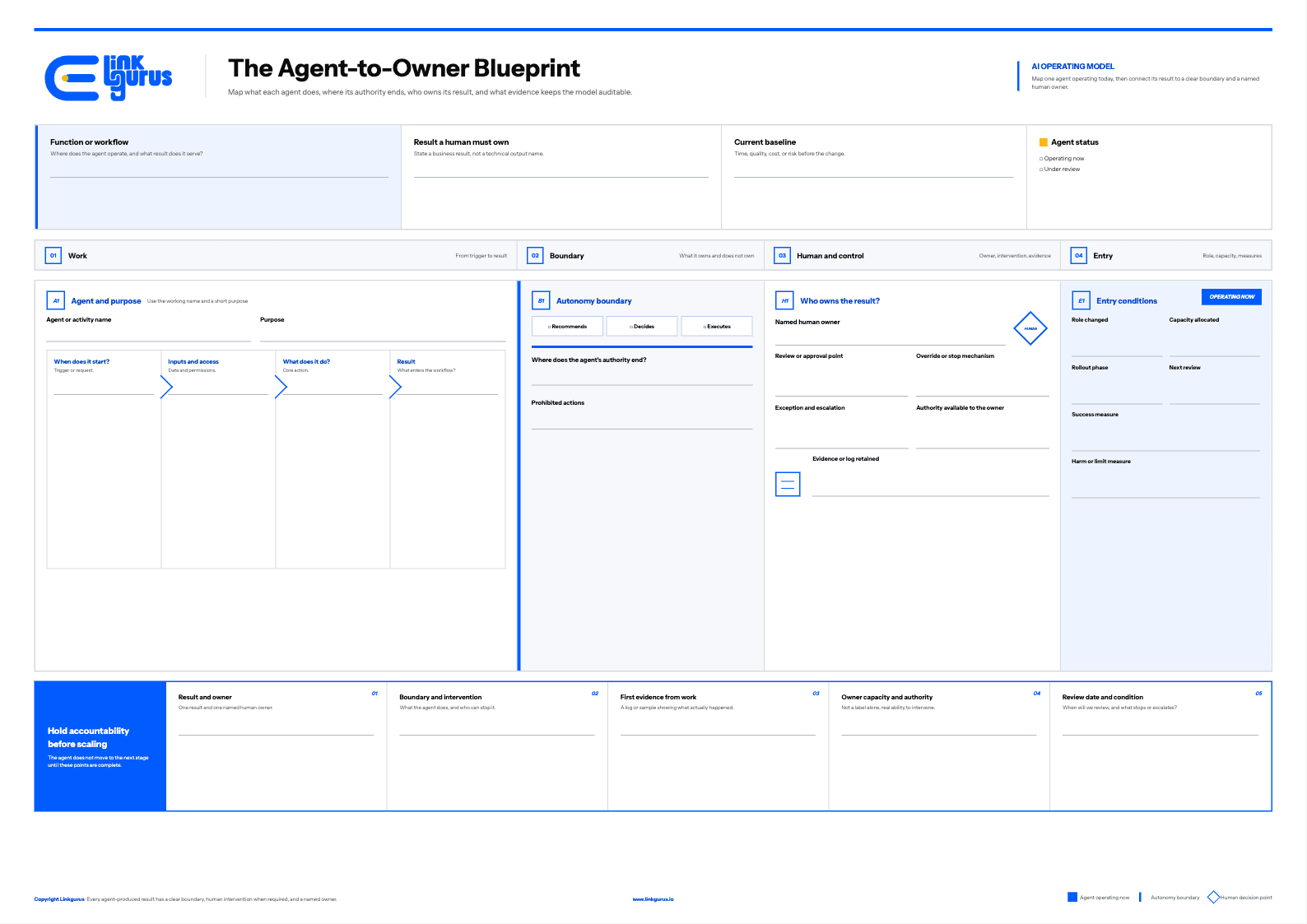
Start with the Agent-to-Owner Blueprint
The Agent-to-Owner Blueprint helps you take one agent and connect it to the work it performs and the human who owns its result.
Begin with one agent inside a real workflow, not a general list of tools.
The Blueprint is not a regulatory audit or security assurance. It does not assess the agent's technical model or establish compliance with a regulatory framework.
Use the Blueprint to record:
- The agent and its role.
- The workflow it enters.
- The decisions and results it affects.
- The named human owner of every result.
- The agent's authority boundary.
- The control and human review point.
- The escalation and manual-override rule.
- The reference trail required when an output or decision is reviewed.
Do not scale agents before knowing who owns their results
Begin with the agents operating now, the decisions they touch, and the results that must retain a named human owner. From there, we can define the scope of the operating model, the functions it should enter first, and the authority and controls required before wider use.